About this practice
Resource Mapping is a simple way to notice what already helps you feel steady and do what matters—then turn it into small, realistic steps. Instead of focusing on problems, you gather your strengths, supportive people, helpful tools and places, and the values that motivate you. Research on strengths use, social support, and “if–then” planning shows that clarifying resources can lower stress, improve follow‑through, and increase wellbeing. This practice is practical, creative, and suitable for anyone who wants more clarity, confidence, and everyday support.
Preparation
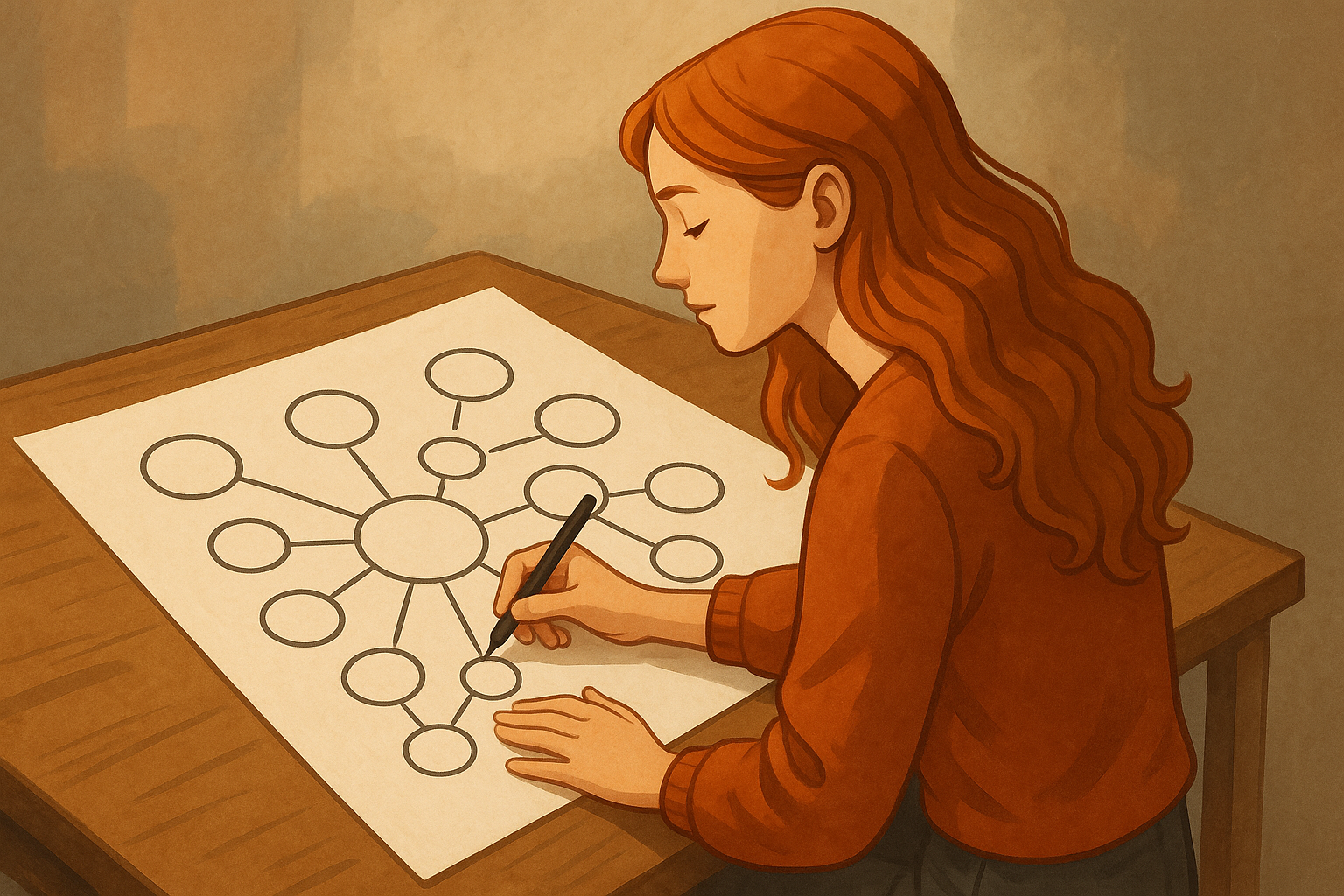
Set aside 20–40 minutes in a quiet spot. Use a notebook, a sheet of paper, or a notes app. Draw a circle in the middle and write “Me.” Around it, leave space for four areas: Inner strengths, People and community, Tools and places, Values and motivation.
Instructions
- Arrive and set intention. Sit comfortably, relax your shoulders, and take one slow breath. Write today’s date and one sentence about what you want this map to support (for example, “more calm after work” or “easier mornings”).
- Gather your resources. For each area, jot short, concrete phrases. Inner strengths: qualities you rely on, skills you’ve built, times you handled challenges. People and community: friends, family, colleagues, mentors, groups, or professionals who are kind or dependable. Tools and places: routines, apps, notes, music, movement, nature spots, libraries, financial or practical supports. Values and motivation: what matters to you—learning, kindness, health, creativity, service.
- Draw your map. Place items that feel most helpful closer to “Me.” Add lines where things connect (a morning walk links to “health,” “friend I text,” and “park path”). Keep it simple; it’s a living sketch, not a perfect diagram.
- Check access and ease. Mark each item as easy, medium, or hard to use right now. For anything not easy, write one small way to make it easier—schedule it, ask for help, set a reminder, move an object where you’ll see it.
- Turn supports into tiny actions. Choose two or three items and create small, specific “if–then” plans. Examples: “If it’s 8:30 p.m., then I make tea and read for 10 minutes”, “If I feel pre‑meeting nerves, then I message a colleague and take three slow breaths”, “If lunchtime arrives, then I walk around the block and notice three trees”.
- Close and track. Underline one takeaway from your map. Pick one plan to try in the next 24 hours. Tomorrow, add a one‑line note: what you used, what helped, and one tweak for next time.
Prompts to explore
- When have I handled something similar well, and what supported me?
- Which person, place, or practice helps me feel even 10–20% steadier?
- What small change today would make it easier to use one resource this week?
Rhythm and updates
Spend 5–10 minutes each week to review and refresh your map. Add new supports, adjust what’s realistic, and refine your if–then plans as your life changes.
Practice with Care
Your map is a tool for everyday support, not a crisis plan. If you feel overwhelmed, focus on one resource and one tiny action, or pause to ground in your senses. Protect your privacy when listing names or locations. Consider inviting a trusted friend to build maps together, or consult a mental health professional if strong emotions or complex obstacles arise. With steady, gentle use, a Personal Resource Map can boost clarity, reduce stress, and help you move toward a life that feels more supported and meaningful.